
The Future of Digital Marketing Isn't AI—It's Human Intelligence Enhanced by AI
Introduction
What if the biggest advantage in the future of digital marketing isn’t the AI tool you use, but the intelligence behind how you use it?
Artificial intelligence is transforming digital marketing by helping businesses analyse data, create content, understand audiences, and automate repetitive tasks faster than ever. But speed alone does not create a successful marketing strategy. The future of digital marketing depends on combining AI capabilities with human thinking, creativity, judgement, and customer understanding.
AI can identify patterns, generate ideas, and process information at scale. Humans decide which insights matter, what the audience actually needs, and how a brand should respond. This shift is creating a new approach to marketing: human intelligence enhanced by AI.
So, will AI replace digital marketers—or change what great marketing looks like? The real opportunity lies beyond that question. It is about learning how AI can make human-led digital marketing smarter, more relevant, and more effective.
AI Is Changing Digital Marketing, But Humans Still Set the Direction
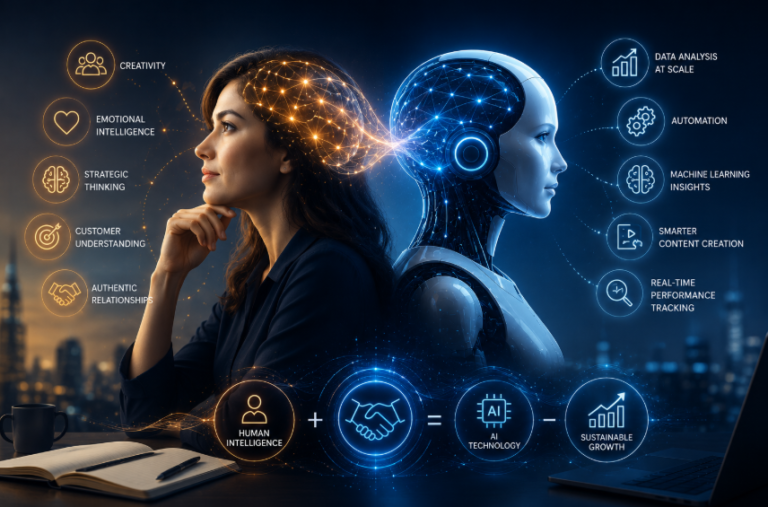
The future of digital marketing is not about choosing between artificial intelligence and human intelligence. It is about combining both to create a smarter marketing system. AI can process information, identify patterns, automate repetitive work, and generate ideas at remarkable speed. However, human marketers provide the context needed to turn those capabilities into meaningful business decisions.
This creates a new approach: human intelligence enhanced by AI.
1. Customer Understanding Comes Before AI
AI can analyse customer data, search behaviour, engagement patterns, and campaign results. But numbers alone do not explain the complete customer story.
A human marketer can connect data with real customer problems, motivations, expectations, culture, and buying behaviour. This understanding helps businesses create messages that feel relevant instead of simply personalised.
The process should therefore begin with a human question:
What does the customer actually need?
AI can then help analyse information and identify useful patterns.
2. AI Makes Marketing Research More Efficient
Traditional digital marketing research can require considerable time. AI can support keyword research, competitor analysis, audience research, content ideas, performance analysis, and trend discovery.
But collecting information is only the beginning.
The marketer must determine which insights are useful for the business and which are simply interesting data. This human interpretation can turn AI-generated information into an actionable digital marketing strategy.
3. Better Content Needs More Than AI Generation
AI can help marketers create blog outlines, captions, headlines, advertisements, and content ideas quickly. Yet producing more content does not automatically mean producing better marketing.
Strong content needs a clear purpose.
It should answer a customer question, solve a problem, communicate the brand’s personality, and guide the reader toward the next action. Human creativity and editorial judgment help transform AI-generated ideas into original, useful content.
This is particularly important for SEO content, where satisfying search intent matters more than simply inserting keywords.
4. AI + Human Thinking Can Improve SEO
AI can assist with keyword discovery, content organisation, topic research, optimisation suggestions, and identifying content gaps.
Human expertise is still needed to understand why someone searches for a particular topic and what information they expect to find.
For example, a business website should not simply target the keyword “digital marketing services.” It should understand whether the searcher wants information, a service provider, pricing, examples, or a solution to a specific marketing problem.
The combination of search data and human understanding creates more useful content.
5. Marketing Works Best as a Connected System
Social media, SEO, Google Ads, Meta Ads, content, and websites should not operate independently.
A social media post may attract attention. SEO may bring organic visitors. An advertisement may generate interest. A well-designed WordPress website or landing page can then turn that interest into an enquiry.
AI can help analyse each stage, but humans need to connect those stages into one customer journey.
6. The Future Marketer Will Be a Decision-Maker
As AI handles more repetitive marketing activities, marketers can spend more time on strategy, creativity, customer understanding, experimentation, and business decisions.
The valuable skill will not simply be knowing how to use an AI tool.
It will be knowing what to ask, what to create, what to change, and when not to follow an AI recommendation.
That is the real opportunity behind AI-powered digital marketing.
AI can provide speed and scale. Human intelligence provides purpose and direction.
When both work together, businesses can create digital marketing that is not only faster, but also more relevant, strategic, and connected to real customer needs.
Conclusion: Human Intelligence Will Shape the Future of Digital Marketing
The future of digital marketing is not simply about using more AI tools. It is about using artificial intelligence with the right human direction. AI can analyse data, automate repetitive tasks, generate ideas, and improve marketing efficiency. Human intelligence adds strategy, creativity, empathy, critical thinking, and customer understanding needed to turn those capabilities into meaningful results.
For businesses, AI can become a powerful support system for SEO, social media marketing, content creation, Google Ads, Meta Ads, and website optimisation. The goal is not to replace human decision-making but to make it smarter and more efficient.
For more insights on building a strong online presence, connect with a Social Media Marketing Expert and WordPress Web Developer who can combine social media strategy, SEO, content, and professional website development to support your business goals.
Ultimately, AI provides speed and scale, while human intelligence provides purpose and direction. The future of digital marketing belongs to businesses that know how to combine both effectively.