
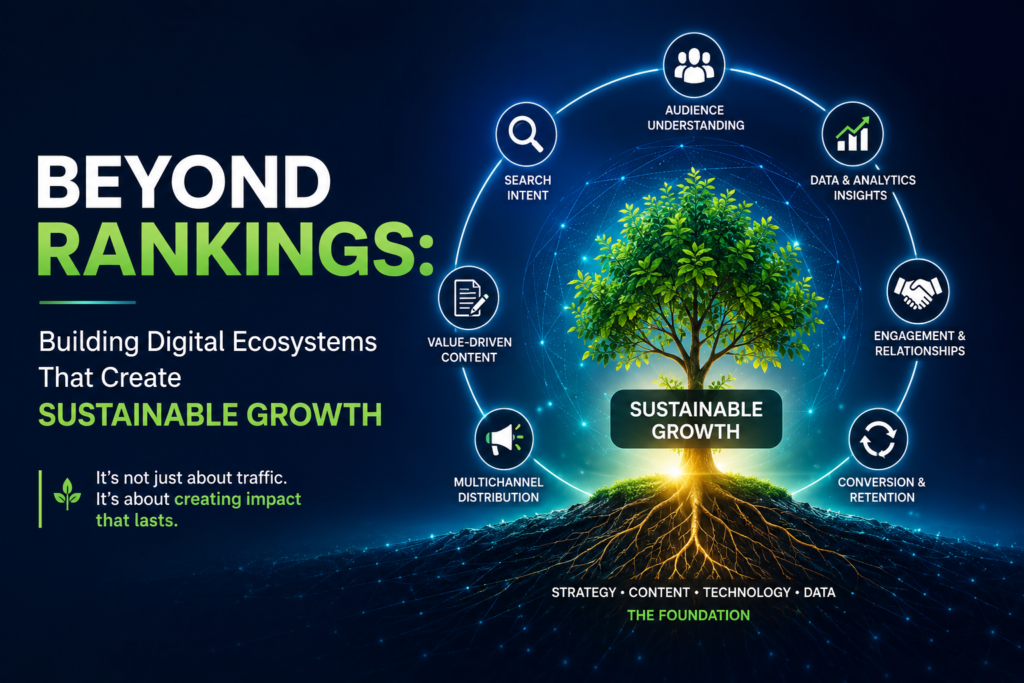
Beyond Rankings: Building Digital Ecosystems That Create Sustainable Growth
Why SEO Alone Doesn't Grow Businesses—Connected Digital Systems Do
By Dilbar Jinan | Digital Marketing Strategist
Introduction: The Question Every Business Should Be Asking
One of the most common questions I hear from business owners is:
“Can you help us rank #1 on Google?”
It’s a reasonable question. After all, search visibility matters.
But after spending eight years helping businesses improve their digital presence, I’ve realized something important:
Ranking #1 isn’t the finish line. It’s simply the beginning of a customer’s journey.
I’ve seen websites dominate search results yet struggle to generate leads. I’ve seen businesses spend heavily on Google Ads only to watch potential customers leave within seconds. I’ve also seen brands with modest traffic consistently outperform larger competitors because they built an experience people trusted.
That’s when I stopped thinking about digital marketing as a collection of channels and started seeing it as something much bigger.
I call it a Digital Ecosystem.
A digital ecosystem isn’t just SEO, paid advertising, social media, or email marketing. It’s the strategic connection between every digital touchpoint that influences how customers discover, evaluate, trust, and choose your business.
Businesses don’t grow because one marketing tactic performs well.
They grow because every part of their digital presence works together.
Why Digital Marketing Is No Longer About Individual Channels
Years ago, businesses could rely on one strong channel.
Rank well on Google.
Run Facebook Ads.
Send promotional emails.
Post regularly on social media.
Today, customer behavior has changed.
People discover brands in one place, research them somewhere else, compare alternatives on another platform, read reviews, visit websites multiple times, and often purchase days—or even weeks—later.
Modern customers don’t experience your marketing channel by channel.
They experience your brand as one connected journey.
That’s why disconnected marketing creates disconnected results.
The New Customer Journey
Imagine someone searching for a solution.
They discover your website through Google.
They read one article.
They leave.
Later they notice one of your Instagram posts.
A few days later they see your Google Ad.
Then they subscribe to your newsletter.
They receive valuable emails.
Weeks later they finally contact you.
Which channel generated the conversion?
The answer is simple.
All of them did.
Every interaction built trust.
Every touchpoint reduced uncertainty.
Every experience moved the customer closer to making a decision.
This is why attribution is becoming more complex—and why strategy matters more than ever.
SEO Is the Beginning, Not the Destination
As an SEO professional, I appreciate the value of search visibility.
But I also believe SEO has been misunderstood.
SEO isn’t about chasing algorithms.
It’s about understanding people.
Keywords reveal intent.
Search queries reveal problems.
Content provides answers.
Trust creates action.
When I build an SEO strategy, I don’t ask,
“Which keyword has the highest search volume?”
Instead, I ask,
“What problem is this customer trying to solve?”
That small shift changes everything.
Because businesses don’t earn sustainable rankings by publishing more content.
They earn them by becoming genuinely useful.
Google's Direction Makes One Thing Clear
Recent developments like Helpful Content Updates, AI-powered search experiences, E-E-A-T, and AI Overviews all point toward the same conclusion:
Google wants to reward businesses that deserve visibility.
That means:
- Real expertise over keyword stuffing.
- Helpful resources over content written solely for rankings.
- Authentic experience over generic AI-generated pages.
- Strong brands over anonymous websites.
Technology continues to evolve.
The purpose of search does not.
People still want trustworthy answers.
Businesses that consistently provide them will continue to thrive.
Content Isn't About Publishing More
One misconception I often encounter is that content marketing means producing endless articles.
I disagree.
Content is not measured by quantity.
It’s measured by usefulness.
When I create a content strategy, I think about three questions.
What does the customer need to know?
What uncertainty can we remove?
What information will help them make a confident decision?
Sometimes one outstanding article creates more business value than fifty average ones.
Because great content builds authority.
Authority builds trust.
Trust creates conversions.
Websites Should Remove Friction, Not Create It
A website is often the first real conversation a business has with a potential customer.
Unfortunately, many websites make that conversation difficult.
Slow loading pages.
Confusing navigation.
Weak messaging.
Poor mobile experiences.
Hidden calls-to-action.
Every unnecessary obstacle increases friction.
Every second of delay reduces momentum.
I believe websites should feel effortless.
Visitors should immediately understand:
- Who you are.
- What you offer.
- Why it matters.
- What they should do next.
Great design is important.
Great user experience is essential.
Why Data Matters—But Only With Context
Digital marketing provides more data than ever before.
Traffic.
Bounce rates.
CTR.
Conversions.
ROAS.
Engagement.
Heatmaps.
Scroll depth.
Session recordings.
Analytics are incredibly valuable.
But numbers alone don’t tell stories.
They raise questions.
Why are visitors leaving?
Why aren’t people clicking?
Why is one landing page converting better?
Why does one audience perform differently?
This is where strategy becomes indispensable.
Data tells us what happened.
Curiosity helps us understand why.
Paid Advertising Should Accelerate Growth—Not Compensate for Weakness
Businesses often believe advertising will solve every growth challenge.
Sometimes it does.
Often it exposes deeper ones.
Google Ads can generate qualified traffic quickly.
Meta Ads can introduce businesses to entirely new audiences.
But neither platform can consistently overcome:
- Poor positioning.
- Weak offers.
- Low trust.
- Confusing messaging.
- Frustrating websites.
Advertising magnifies reality.
Strong businesses become stronger.
Weak customer experiences become more expensive.
That’s why I spend just as much time thinking about landing pages, messaging, and offers as campaign settings.
Email Marketing Is About Relationships
Many people view email as a promotional tool.
I see it differently.
Email is an opportunity to continue conversations.
Customers rarely purchase because of one interaction.
They purchase because trust develops over time.
Educational emails.
Helpful insights.
Relevant recommendations.
Consistent communication.
Every email should strengthen the relationship—not simply ask for another sale.
In a world dominated by algorithms, your email list remains one of your most valuable business assets.
Because it’s a relationship you own.
The Role of AI in Digital Marketing
Artificial Intelligence has become one of the biggest conversations in marketing.
Some people believe AI will replace marketers.
I don’t.
I believe it will replace repetitive tasks.
Not strategic thinking.
AI helps me:
- Organize research.
- Speed up workflows.
- Analyze information.
- Generate ideas.
- Increase productivity.
But AI cannot replace empathy.
It cannot replace judgment.
It cannot replace understanding the subtle emotions that influence human decisions.
The future belongs to marketers who combine technology with wisdom.
Not one or the other.
The Digital Ecosystem Framework
Every successful digital strategy I build revolves around one connected system.
1. Discovery
SEO.
Google Ads.
Meta Ads.
Social Media.
Content.
Customers discover your business.
2. Trust
Educational content.
Helpful resources.
Case studies.
Testimonials.
Clear messaging.
Trust begins to develop.
3. Experience
Fast website.
Simple navigation.
Strong UX.
Clear CTAs.
Visitors become confident.
4. Conversion
Landing pages.
Copywriting.
Email sequences.
Offers.
People become customers.
5. Retention
Follow-up emails.
Helpful content.
Customer support.
Remarketing.
Satisfied customers return.
6. Advocacy
Reviews.
Referrals.
Recommendations.
Brand loyalty.
Customers become ambassadors.
When every stage supports the next, growth becomes predictable rather than accidental.
The Biggest Lesson I've Learned
Earlier in my career, I believed success meant increasing traffic.
Today, I believe success means increasing value.
Value for customers.
Value for businesses.
Value through better experiences.
Traffic without trust accomplishes very little.
Clicks without clarity rarely convert.
Visibility without credibility doesn’t create sustainable growth.
The businesses that consistently grow aren’t always the loudest.
They’re often the most helpful.
My Philosophy
Marketing isn’t about convincing people to buy.
It’s about helping the right people make better decisions.
SEO isn’t about pleasing search engines.
It’s about helping customers find answers.
Advertising isn’t about interruption.
It’s about introducing valuable solutions.
Websites shouldn’t impress visitors.
They should guide them.
Content shouldn’t fill space.
It should solve problems.
Data shouldn’t replace intuition.
It should strengthen it.
AI shouldn’t replace marketers.
It should make great marketers even better
Final Thoughts
Digital marketing has evolved from isolated tactics into interconnected systems.
Businesses no longer compete on who publishes more content.
They compete on who creates the best experience.
The future belongs to organizations that integrate SEO, content marketing, paid advertising, web development, analytics, email marketing, and customer psychology into one seamless ecosystem.
Because sustainable growth isn’t built by mastering a single platform.
It’s built by understanding people, earning trust, and creating meaningful digital experiences at every stage of the customer journey.
And that’s exactly how I approach digital marketing.
Not as a collection of services.
But as a connected system designed to help businesses grow—strategically, sustainably, and with purpose.
About the Author
Dilbar Jinan is a Digital Marketing Strategist with 8 years of experience specializing in SEO, Google Ads, Meta Ads, Performance Marketing, Content Marketing, Copywriting, Email Marketing, Web Development, and Analytics. His philosophy is simple: sustainable growth begins with understanding customers, building trust, and creating digital ecosystems where every marketing channel works together to deliver measurable business results.